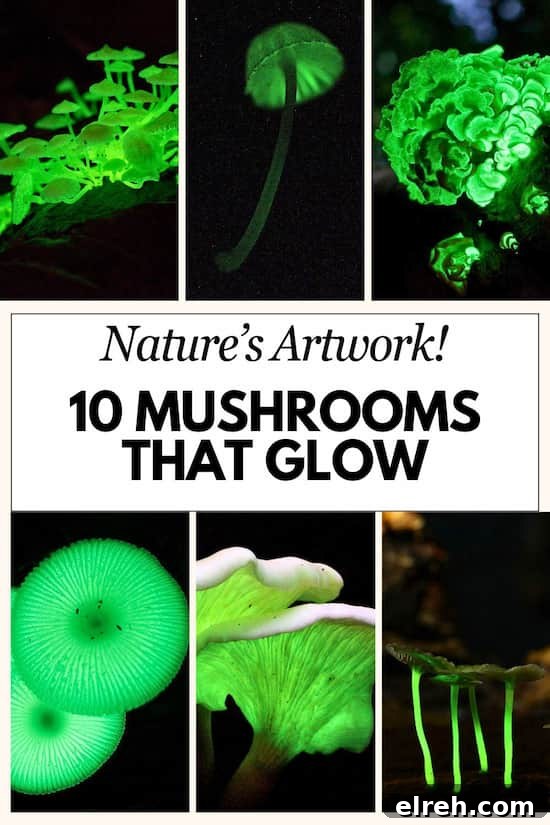
One of nature’s most captivating phenomena is the sight of mushrooms that glow in the dark. Often called “foxfire” or “fairy fire,” these bioluminescent fungi draw the attention of scientists, photographers, and nature lovers worldwide.
This article examines bioluminescent mushrooms: how their light is produced, where they grow, and why their glow matters to ecosystems and to those who study them.
The Science Behind Bioluminescence
Mushroom bioluminescence is a chemical process inside the fungus. A molecule called luciferin reacts with oxygen under the action of an enzyme, luciferase, producing light. The color of this light typically ranges from blue to green, and its intensity and duration vary by species.
In some species the glow is continuous; in others it appears only under certain conditions, such as high humidity or during specific stages of growth.
Mushrooms That Glow In The Dark
1. Omphalotus olearius (Jack-o’-Lantern Mushroom)
The Jack-o’-Lantern mushroom is found across Europe and North America. Its gills emit a greenish light that is striking at night. Although beautiful, this species is toxic and should not be eaten.
These mushrooms usually grow on decaying wood in clusters, and their glow is most obvious in complete darkness, making them a memorable sight on night walks.
2. Panellus stipticus (Bitter Oyster)
The Bitter Oyster occurs in North America, Europe, and Asia. It prefers damp, shaded wood and plays a role in breaking down dead organic material.
Compared with some species, its glow is subtle and is usually visible only in very dark conditions, especially when the mushroom is moist.
3. Mycena chlorophos
Mycena chlorophos thrives in subtropical regions of Asia and Australia. These small mushrooms emit a gentle green light and commonly appear in clusters on decaying wood during the wet season.
Their persistent glow in humid, dark forests creates an almost surreal atmosphere that attracts photographers and researchers alike.
4. Armillaria mellea (Honey Fungus)
The Honey Fungus is widespread in temperate forests and is known for causing root rot in trees. Its mycelium can produce a faint bioluminescent light, especially visible in decaying wood where the fungal network is extensive.
Although not as bright as some species, the large colonies of Armillaria can create a noticeable, haunting glow across the forest floor.
5. Neonothopanus gardneri
Neonothopanus gardneri is a rare Brazilian species that produces a strong greenish-yellow light. Locally known as flor-de-coco, it has traditionally been used as a natural lantern due to its intense glow.
Its brightness makes it a subject of focused scientific study into the mechanisms and potential applications of fungal bioluminescence.
6. Mycena lucentipes
In South American rainforests, Mycena lucentipes gives off a soft blue-green glow. Growing on decaying wood in clusters, its light peaks during the wet season and may help attract insects that disperse spores.
7. Mycena haematopus (Bleeding Fairy Helmet)
Mycena haematopus, known as the Bleeding Fairy Helmet, appears in Europe and North America. It emits a faint glow most visible in very dark settings and is named for the reddish latex that oozes from damaged gills.
This species helps decompose dead wood, contributing to nutrient cycling in its habitat.
8. Mycena pura
Widespread across Europe and North America, Mycena pura emits a delicate glow from its gills. It grows in forests and grasslands, often in small groups, and plays an important role in breaking down organic matter.
Although its light is faint compared with some species, it can be a striking discovery during after-dark explorations.
9. Mycena singeri
Native to Costa Rica’s tropical rainforests, Mycena singeri produces a soft bluish glow, often in dense clusters on decaying wood. Its communal illumination creates a beautiful display on the forest floor.
Researchers study this species to learn more about the ecological roles of fungal light in tropical ecosystems.
10. Gerronema viridilucens
Found in Australia and New Zealand, Gerronema viridilucens gives off a greenish bioluminescent glow and prefers damp, shaded woodlands. Its light becomes most noticeable during the wet season.
Studying this species helps scientists better understand the biochemical pathways that produce fungal bioluminescence.
Why Do Mushrooms Glow?
The exact reasons for fungal bioluminescence are not fully resolved, but several credible hypotheses exist:
- Attracting spore dispersers: The light may draw insects or other small animals that help spread spores, aiding reproduction.
- Deterring predators: In some cases the glow could serve as a warning that the fungus is toxic or unpalatable.
- Metabolic byproduct: Bioluminescence might also arise as a byproduct of metabolic processes without a direct evolutionary benefit.
Tips for Finding Bioluminescent Mushrooms
- Choose the right time: Visit after sunset on moonless nights for the best visibility.
- Use a red-filtered light: A flashlight with a red filter preserves night vision while helping you navigate.
- Search low: Look on decaying logs, stumps, and leaf litter where many bioluminescent species grow.
- Be patient: Allow your eyes to adapt to the dark; some glows are very faint and emerge gradually.
Final Thoughts On Bioluminescent Mushrooms
Bioluminescent mushrooms are one of the darker world’s most enchanting natural spectacles. From the vivid glow of Neonothopanus gardneri to the subtle shimmer of the Honey Fungus, these fungi illuminate forest floors around the globe and invite scientific curiosity.
Whether you are a researcher, a photographer, or simply a curious nature enthusiast, observing glowing mushrooms provides a rare glimpse into a biological process that blends chemistry, ecology, and wonder.